
How court interpreters help defendants follow a trial
A criminal trial depends on spoken words: charges read aloud, evidence given by witnesses, questions from lawyers and directions from the judge. A defendant who does not understand the language of the court cannot follow any of it. The court interpreter is the person who makes that understanding possible, and the right to one is written into many national laws and international treaties.
Why the right to an interpreter exists
The principle is simple. A fair trial means the accused can understand the case against them and answer it. Without that, the hearing may take place, but the defendant is only present in a physical sense.
The European Convention on Human Rights says a person charged with a criminal offence is entitled to the free assistance of an interpreter if they cannot understand or speak the language used in court. The International Covenant on Civil and Political Rights contains a similar guarantee, and so does the Rome Statute of the International Criminal Court. These language rights apply whether the defendant is eventually convicted or acquitted, and the cost does not fall on the accused.
Within the European Union, a 2010 Directive on interpretation and translation in criminal proceedings sets common minimum standards. It covers police questioning as well as court hearings, and it requires states to ensure that interpretation is of a quality sufficient to safeguard fairness. In the United States, the Court Interpreters Act of 1978 provides for interpreters in federal courts, while state systems set their own rules.
What an interpreter does in the courtroom
The court interpreter renders what is said into the defendant's language, and what the defendant says back into the language of the court. The role is neutral. The interpreter does not advise the defendant, argue for either side or explain the law. Their task is to convey the meaning, tone and register of what is said as accurately as possible.
Simultaneous interpreting
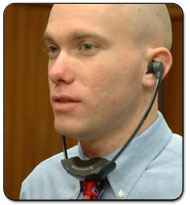
In longer hearings the interpreter often works alongside the speaker, a few moments behind. Sometimes the interpreter sits next to the defendant in the dock and speaks quietly, a technique known as whispered interpreting. Some courts use headsets and microphones so that the defendant hears the interpretation without disturbing the room.
Consecutive interpreting
When a witness is giving evidence in another language, the interpreter usually waits for the witness to finish a short passage and then speaks the English version for the court. This is slower but allows careful, complete renderings. It is the normal method when a defendant or witness testifies through an interpreter.
Sight translation
Interpreters may also be asked to read a short document aloud in another language, such as a charge sheet or a bail condition. Longer written material is dealt with by translators rather than interpreters.
Beyond the hearing itself
Under most systems of criminal procedure, the entitlement does not begin when the trial opens. A suspect who is arrested and interviewed usually needs an interpreter at the police station, and again when meeting a lawyer. Those private consultations matter as much as the public hearing, because that is where legal advice is given and decisions about plea are made. Interpreters in these settings are bound by confidentiality.
Written documents are also covered. The EU Directive, for example, requires translation of essential documents, which include any decision depriving a person of liberty, the charge or indictment and any judgment. Not every document has to be translated in full, and the rules allow an oral summary in some circumstances, provided fairness is not harmed.
The same principle extends to defendants who are deaf. Sign language interpreters are used in courts in many countries, and the reasoning is the same as for spoken languages.
Standards, oaths and quality
Interpreters in court are normally required to take an oath or affirmation that they will interpret faithfully and completely. Many jurisdictions maintain registers or certification schemes, though the strictness varies widely. Some countries test interpreters formally for court work; others rely on recognised qualifications and experience. For rarer languages, qualified interpreters can be hard to find, and hearings are sometimes delayed while one is arranged.
Accuracy matters because small differences in wording can affect how evidence is understood. Idioms, dialects and legal concepts that have no direct equivalent all pose difficulties. For that reason, interpreters may ask a speaker to repeat or clarify, and judges are expected to allow time for the interpretation to be completed.
When problems arise
If a defendant says they cannot follow the interpreter, or a lawyer believes the interpretation is faulty, the judge can pause proceedings, question the interpreter or replace them. Courts may also have to decide at the outset whether a defendant needs an interpreter at all. Under the EU Directive, there must be a way to challenge a decision that interpretation is not needed.
Appeals sometimes turn on interpretation. A conviction may be challenged on the ground that the defendant could not understand key parts of the proceedings, although appeal courts usually look at whether the lack of understanding actually affected the fairness of the trial.
Why it matters
The court interpreter is rarely the centre of attention, yet the role is a basic safeguard. The right to interpreter turns a formal guarantee of a fair hearing into something a defendant can use in practice: to understand the charge, instruct a lawyer, listen to the evidence and give their own account in their own language.