
How a criminal trial begins: opening statements, first witness
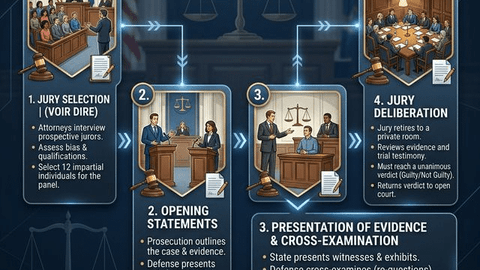
The start of a criminal trial follows a set order, and the early steps shape how jurors understand everything that comes after. Before any evidence is heard, the court explains the charge, the prosecution outlines its case, and a first witness is called. This guide sets out how that opening phase usually works in common law systems such as those of England and Wales and the United States. Details differ between courts and countries.
Before the opening statement
By the time a trial starts, the defendant has normally entered a plea at an earlier hearing. In a trial before a jury, the first task is to swear in the jurors. The judge then explains their role: they decide the facts, while the judge decides the law and runs the courtroom.
In England and Wales, the charge on the indictment is read out in front of the jury, who are told that the defendant has pleaded not guilty. In many US courts, the judge gives preliminary instructions covering the burden of proof, the need to keep an open mind and the ban on researching the case or discussing it outside the jury room. Where a judge sits without a jury, these steps are shortened, but the trial still opens with the charge and a statement of the issues.
The opening statement
What it is for
The opening statement is the prosecution's first chance to speak to the jury. Its purpose is to give a framework: who the people in the case are, what the prosecution says happened, and what evidence the jury can expect to hear. Many lawyers compare it to a map, because it helps jurors place each piece of evidence when it arrives.
What it is not
An opening statement is not evidence. Jurors are told to base their verdict only on what witnesses say under oath, on exhibits, and on any facts the parties have formally agreed. Lawyers are expected to confine their openings to material they genuinely expect to prove. They should not argue the case at length, offer personal opinions or mention material that the judge has ruled inadmissible. If a lawyer goes too far, the other side can object and the judge may tell the jury to disregard the remarks.
The defence response
Practice differs here. In US courts, the defence can usually make its own opening statement straight after the prosecution, or wait until the start of the defence case, or in some situations decline to make one. In England and Wales, the defence does not normally address the jury at this stage. A defence opening is more likely at the start of the defence case, depending on the evidence to be called. In every system the defendant is presumed innocent, and the prosecution carries the burden of proving guilt to the required standard.
Calling the first witness
After the openings, the prosecution begins to present its evidence. The choice of first witness is a matter of tactics, but it is often someone who sets the scene. That might be the person who raised the alarm, a first officer at the scene, or a family member who can describe the victim's life in general terms. Some prosecutors prefer to start with a witness whose account is clear and easy to follow, so the jury has a firm base to work from.
The witness takes an oath or makes an affirmation to tell the truth. The prosecution lawyer then asks questions, known as examination-in-chief in England and Wales and as direct examination in the United States. These questions are meant to be open, allowing the witness to tell the story in their own words. Leading questions, which suggest the answer, are generally not allowed at this stage, apart from background points that nobody disputes.
Cross-examination and re-examination
When the prosecution has finished, the defence lawyer may cross-examine. This is the main way of testing a witness's account. The defence may probe for inconsistencies, challenge how reliable a recollection is, or put its own version of events. The prosecution can then ask follow-up questions, called re-examination or redirect examination, though only about matters raised in cross-examination.
Documents, photographs, recordings and physical items are often introduced through the early witnesses. The judge decides whether each can be admitted, and the jury is told to treat admitted exhibits as evidence.
The judge's role in the opening phase
Throughout, the judge manages the trial procedure. They rule on objections, ensure questions are fair and allow breaks. They also give directions to the jury as needed, for example about evidence that applies only to one defendant in a joint trial. Jurors may be reminded that the opening statements were not evidence and that no decision should be made until all the evidence and legal directions have been heard.
Reporting the early days of a trial
Once a trial is under way, journalists can report what is said in open court, subject to any reporting restrictions set by the judge. Early coverage usually centres on the prosecution's account, which can sound compelling because the defence has not yet presented its case. For that reason, responsible reports make clear that the material is the prosecution's allegation, not a finding of fact, and that the defendant is presumed innocent until a verdict is reached.
What comes next
After the first witness, the prosecution calls the rest of its witnesses in turn. When the prosecution case closes, the defence may argue that there is no case to answer, and, if that fails, may present its own evidence. The trial then moves on to closing speeches, the judge's summing up and the jury's deliberations. The opening phase may take only a few hours, yet it sets the structure that everything else follows.