
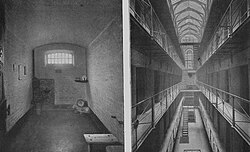
Amelia Dyer: the Reading baby farmer convicted in 1896
Amelia Dyer was convicted of murder at the Old Bailey in London on 22 May 1896 and hanged at Newgate Prison on 10 June the same year. Dubbed the "Ogress of Reading" by the press, she was a Victorian baby farmer: a woman who took in unwanted infants for a fee. She was tried for the death of one child, four-month-old Doris Marmon, but police and historians believe she was responsible for many more deaths over a period of about 27 years.
Who was Amelia Dyer?
Amelia Elizabeth Hobley was born on 27 November 1837 at Pyle Marsh, near Bristol, the daughter of a shoemaker. Her mother suffered from mental illness following typhus, and Amelia helped care for her until her death in 1848. She later served an apprenticeship with a corsetmaker. She married twice, first to George Thomas and later to William Dyer, and she also used other names in her dealings with the public.
She trained as a nurse and was widowed in 1869. That year is generally taken as the start of the period covered by her crimes, which is why the dates 1869 to 1896 are linked with her name. She had two children of her own, and her daughter later became a witness in the case against her.
What was baby farming?
In Victorian England, an unmarried woman who had a baby faced heavy social stigma and often had little means to raise the child. Many answered newspaper advertisements placed by women offering to adopt or nurse a child, usually for a lump sum or a regular payment. There was little supervision. The business model rewarded those who spent as little as possible on each child, and some baby farmers allowed infants to die of neglect or killed them.
Dyer began by caring for children in her charge in a seemingly legitimate way. Over time she moved from neglect to deliberate killing, and she changed addresses and names to avoid attention.
The 1879 conviction and later years
Dyer first came to the authorities' attention after a doctor became suspicious about the number of children dying in her household. In 1879 she was convicted over the neglect of children in her care and sentenced to six months' hard labour. That sentence did not end her activities. She spent time in asylums at various points in her life, and some observers suspected she was feigning illness. She also survived at least one serious suicide attempt.
In her later years she moved around the Reading area and, according to accounts of the case, grew more cautious. Rather than rely on medical certificates and burials, which could draw attention, she disposed of bodies in other ways, including in rivers.
The discovery on the Thames
The case began to unravel at the end of March 1896, when a bargeman found a parcel in the River Thames near Reading. It contained the body of an infant. Wrapping paper inside the parcel carried a partly legible address, which gave police a lead back to Dyer's household in Caversham.
Detectives made enquiries and used an undercover approach to test whether she was still taking in children. Dyer was arrested in early April 1896. Searches of the river then produced further bodies, including those of Doris Marmon and a 13-month-old boy, Harry Simmons. Several of the infants had been strangled with white tape.
Doris Marmon
Evelina Marmon, a young single mother, had advertised in a Bristol newspaper for someone to take her baby. She answered a reply from a woman calling herself "Mrs Harding" and handed over Doris with a fee of £10 at the end of March 1896. She next saw her daughter when she was asked to identify the body at Reading police station.
The trial at the Old Bailey
Dyer's trial took place at the Central Criminal Court, known as the Old Bailey, on 21 and 22 May 1896. Prosecutors chose to proceed on a single charge, the murder of Doris Marmon, rather than attempt to prove each death. This is a common approach when one case is well evidenced, and it would have allowed another charge to be brought if the first had failed.
The defence argued that Dyer was insane. The jury rejected that argument and returned a guilty verdict after a short retirement. Her son-in-law, Arthur Palmer, had been arrested during the investigation but was not charged with murder. The judge passed the mandatory sentence of death.
Execution
Dyer was hanged at Newgate Prison on 10 June 1896, aged 58. No appeal succeeded. Her case drew exceptional press attention, and newspapers treated it as one of the most sensational trials of the Victorian period.
How many people did she kill?
The number cannot be established. Six deaths are confirmed and there is evidence connected to around a dozen. Some writers have suggested the real total could be in the hundreds, but that is an estimate rather than a proven figure. Dyer was convicted of one murder only.
Legacy and legal change
Concern about baby farming predated Dyer. Parliament had already passed the Infant Life Protection Act 1872, which required some carers of infants to register, but enforcement was weak. Dyer's case renewed public pressure for tighter regulation of fostering and adoption and for stronger child protection. It also raised the profile of the National Society for the Prevention of Cruelty to Children, founded in 1884. Later legislation in the early twentieth century brought more oversight, and formal adoption law followed in 1926.
Why the case still matters
The Dyer case is remembered both for the scale of the suspected harm and for what it revealed about the position of unmarried mothers and the weakness of regulation. It remains a reference point in discussions of how the law protects children who have no one to speak for them.