
Acreman family murders: the unsolved Allentown case of 1906
No court has ever heard the case of the Acreman family, who were found dead in the ruins of their home near Allentown, Florida, on 14 May 1906. Nine people died. No one was convicted, and the case remains unsolved. It has since been discussed alongside other axe killings of the period, including the Villisca murders in Iowa in 1912.
What was found on 14 May 1906
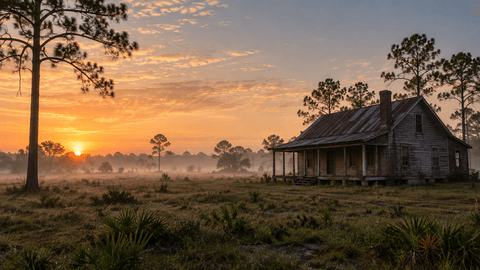
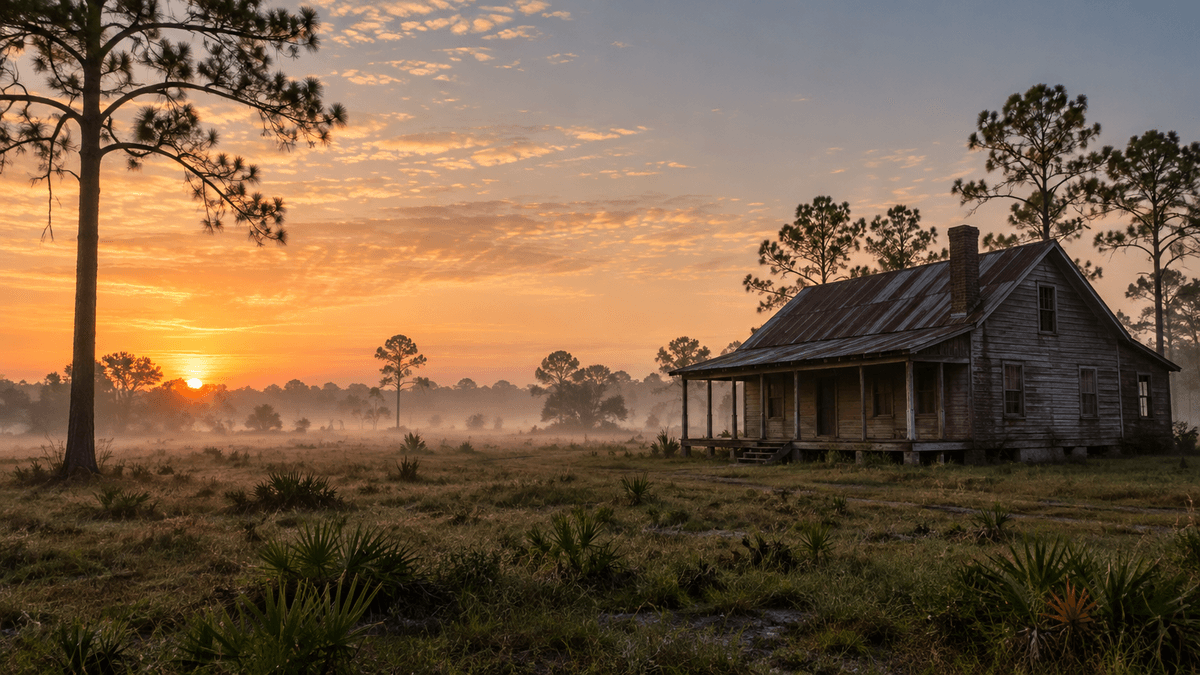
Allentown is a small rural community in Santa Rosa County, in the north-west of Florida, about 10 miles north of Milton. In 1906 it was thinly settled farmland with no organised police force of its own.
Around 10am on 14 May, a neighbour who lived roughly a quarter of a mile away looked towards the Acreman place and could no longer see the house. He alerted other neighbours, and a group went to the site. They found a smouldering ruin and, in it, the burned remains of the family.
The dead were William Glenn Acreman, who was 37 and worked as a tenant farmer and itinerant preacher, and his wife, Amanda. With them were their four sons, two daughters and a three-day-old baby. The fire is thought to have burned for several hours before anyone noticed it.
The injuries and the fire
Accounts of the case agree that the victims had suffered crushing injuries to the skull, consistent with a heavy blunt weapon such as an axe. Reports say an axe was later found in the ruins. The house was then set alight.
The examination of Mr Acreman's body is often cited. His skull was crushed, and a large blood clot at its base led those present to believe he had been killed before the fire began. That suggests the blaze was started afterwards, not that it caused the deaths.
Surviving accounts differ on where some of the bodies lay. Some say the parents and the infant were found outside the building, and others place the mother and baby on the front porch. Because the records are mostly old newspaper reports and later retellings, those details cannot be settled with confidence.
An investigation without a result
The area had no police force of its own, so the early work fell to neighbours and county officials. The scene had been badly damaged by fire, which limited what could be learned from it. Forensic science in 1906 had few tools for a scene like this.
Nobody was charged with the killings, and no trial took place. In legal terms there is therefore no verdict, no sentence and no appeal to report. The only established facts are the deaths, the burning of the house and the nature of the injuries described at the time.
The Villisca connection
The link to Villisca comes from later investigators, not from anything found at the scene. On the night of 9 to 10 June 1912, eight people were killed with an axe in a house in Villisca, Iowa. Six of them were children. That case is also officially unsolved.
During the Villisca inquiries, a Justice Department agent named W. M. McClaughry proposed that one man was responsible for a string of axe murders across several states. His suspect was Henry Lee Moore, who was convicted in 1913 of killing his mother and grandmother with an axe in Columbia, Missouri, in December 1912. The press came to call the supposed killer "Billy the Axeman".
Lists of cases attributed to that theory include the Acreman family. The theory has serious gaps for 1906. Moore was convicted of two murders only. Accounts of his record place a forgery arrest in Kansas in 1910, and nothing shows that he was anywhere near north-west Florida in 1906. His opportunity to commit the Allentown killings has never been shown, and he was never charged with them.
A wider serial theory
The authors Bill James and Rachel McCarty James took a different line in their book The Man from the Train. They argue that a single travelling offender, whom they name as Paul Mueller, committed many family killings over about a decade and a half, including Villisca. In their reading, a fire set after the attack and a lack of survivors are part of a pattern. Allentown appears in some summaries of that work.
This is a historical theory. It has not been tested in court and is not an official finding. Even supporters of the wider series note how few cases can be pinned down in the years immediately after 1906.
Why the case stays open
Several factors explain why the Acreman case has never been resolved:
- The house was destroyed by fire, which removed much of the physical evidence.
- The location was remote, with no established police force to secure the scene.
- Every member of the household died, so there were no witnesses.
- Surviving records are thin and sometimes contradict one another.
Links to other crimes rest on similarities in method, not on physical evidence or testimony. Similarity can be a useful lead for investigators. It is not proof that one person committed every offence in a series.
Where the case stands
More than a century later, the Acreman murders remain an unsolved crime and a sobering local story in Santa Rosa County. What is firmly known is limited: a family of nine died, their home was burned, and no one was ever held responsible. Any link to Villisca or to a travelling killer remains a theory, and none has been proved.