
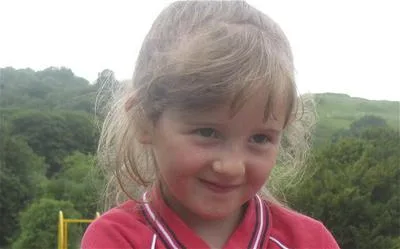
Murder of April Jones: the search, the trial and the sentence
April Jones was five years old when she disappeared from near her home in Machynlleth, Powys, on the evening of 1 October 2012. Her case led to the largest missing person search in UK police history. On 30 May 2013 a jury at Mold Crown Court convicted a local man, Mark Bridger, of her abduction and murder, and of perverting the course of justice. He was sentenced to life imprisonment with a whole life order. Her body has never been found.
The disappearance
April had been to swimming lessons at a local leisure centre that evening, while her parents attended a parents' evening at her school. Afterwards she was allowed to play outside with friends on the Bryn-y-Gog housing estate. Her parents last saw her at about 7pm, and she was seen playing with friends at 7.15pm.
At 7.29pm her mother could not find her and called 999. Dyfed-Powys Police sent an officer, who spoke to a child witness. The child said April had got into a grey van. The force quickly declared a critical incident and began a large search of the town. Hundreds of civilians, some alerted through social media, had joined in by the early hours of 2 October.
The search
April's mother made a public appeal for information on 3 October. The next day the then Prime Minister, David Cameron, also urged the public to come forward. He noted that April had cerebral palsy. Police and search and rescue teams with specialist equipment worked alongside hundreds of volunteers around Machynlleth.
In December 2012 police said the search would continue into 2013. In March 2013 they said they would call it off, and it formally ended on 22 April. Police said a reactive team of specialist officers would remain available to act on any new information.
Arrest and charges
Bridger, then aged 46, was arrested on the afternoon of 2 October 2012, less than 24 hours after April was reported missing. He became a suspect because he and his vehicle, a left-hand drive Land Rover Discovery, matched the descriptions given by an eyewitness.
On 5 October police formally made the case a murder inquiry even though no body had been found. Media coverage of that announcement drew criticism online, because it was broken live on air to volunteers who were still searching.
Bridger was charged on 6 October with abduction, murder and attempting to pervert the course of justice. At Aberystwyth magistrates' court on 8 October he faced an additional charge of unlawfully concealing and disposing of a body. He was remanded in custody and appeared by video-link at Caernarfon Crown Court on 10 October.
Plea before trial
At Mold Crown Court on 14 January 2013, Bridger pleaded not guilty to murder. He accepted, however, that he was probably responsible for April's death. A trial planned for 25 February was put back at the defence team's request so that further enquiries could be made.
The trial at Mold Crown Court
The trial began on 29 April 2013 before Mr Justice Griffith Williams and lasted a little over four weeks. The jury heard that Bridger had told a series of lies after April vanished. Prosecutors said traces of her blood were found in several rooms of the cottage he rented. They also said bone fragments recovered from the remains of a fire at the property were consistent with a child's skull. The prosecution case was that the killing was sexually motivated.
Bridger told the court that he had hit April with his vehicle while drunk. He said he could not remember what he did afterwards. The jury rejected that account.
Verdict and sentence
On 30 May 2013 the jury took just over four hours to find Bridger guilty on all counts. He was convicted of:
- murder;
- child abduction; and
- perverting the course of justice.
The judge imposed a whole life order. This is the most severe sentence available in England and Wales. It means the offender will not be considered for release on parole and is expected to die in prison. Such orders are reserved for the gravest cases, and the judge must be satisfied that the seriousness of the offence justifies one.
The appeal that was dropped
Bridger applied for permission to challenge his whole life order at the Court of Appeal. A hearing had been expected in London on 24 January 2014. On 13 January 2014 the Judicial Office confirmed that he had abandoned the application. The sentence therefore stands.
Why the case is still referred to
The case is often cited in discussions of how communities and police respond when a child goes missing. Volunteers and social media played a large part in the early search. The speed of the arrest, within a day, contrasted with the long search that followed for April herself. The case is also a reference point in debates about whole life orders. Courts in England and Wales have since cited it among the cases in which such a sentence has been imposed.
It also shows that a murder conviction does not depend on finding a body. Prosecutors relied on forensic evidence, witness accounts and the defendant's own conduct. The jury was satisfied of guilt, and the verdict was not overturned.