
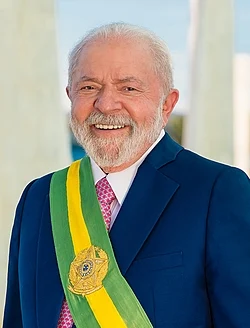
Lula: from jailed ex-president to fourth term in office
Luiz Inácio Lula da Silva, widely known as Lula, was declared the winner of Brazil's presidential runoff on 25 October 2026, securing a fourth, non-consecutive term. He is 80 and turns 81 this week. His career has included two spells as head of state and a period in prison after corruption convictions, which Brazil's Supreme Court later annulled on procedural grounds.
The result of the 2026 election
The runoff was held on 25 October 2026 between Lula, the incumbent from the Workers' Party, and Senator Flávio Bolsonaro, son of the former president Jair Bolsonaro. Reports put Lula's share of the valid vote at just over 51%, with Bolsonaro on a little under 49%. The margin was several million votes.
Bolsonaro had finished ahead in the first round on 4 October, winning about 47% against about 45% for Lula. Since democracy was restored in 1989, no candidate who failed to win the first round had gone on to win the second.
The outcome is not free of dispute. Flávio Bolsonaro has rejected the result, while his party has said it recognises the outcome but wants questions about the vote clarified. Any formal challenge would be a matter for Brazil's electoral authorities and courts.
From metalworker to president
Lula rose from a poor background to become a metalworker and then a prominent trade union leader. He was a founding figure of the Workers' Party and ran for the presidency several times before winning in 2002. He governed from 2003 until 2010, a period often associated with economic growth and the expansion of social programmes.
He returned to office by defeating Jair Bolsonaro in the 2022 runoff, after a first round in which Bolsonaro performed better than polls had suggested. That result came after a long absence from elected office that was caused by the legal cases described below.
The Operation Car Wash cases
Investigation and convictions
Operation Car Wash (Lava Jato) was the largest anti-corruption investigation in Brazil's history. It uncovered a kickback scheme at the state oil company Petrobras. Lula was investigated as part of it and was convicted of corruption and money laundering in Curitiba in 2017. That case concerned a beachfront apartment in Guarujá that prosecutors alleged the builder OAS had promised him in return for favours. He was later convicted in a second case, concerning a country property in Atibaia.
Lula denied wrongdoing throughout. He has always maintained that the prosecutions were politically motivated. The first conviction was upheld on appeal, which made him ineligible to stand in the 2018 election, a contest he had been leading in the polls.
Imprisonment
He began serving his sentence in April 2018 and was released in November 2019, after about 580 days. His release followed a Supreme Court ruling that defendants may remain free while their appeals are pending.
Annulment of the convictions
On 8 March 2021 Justice Edson Fachin annulled the convictions. His reasoning was about jurisdiction: the federal court in Curitiba, he found, was not the right forum for these cases, which did not concern money taken from Petrobras. The cases were sent to the federal court in Brasília. The full Supreme Court upheld his decision by eight votes to three.
The court also examined the conduct of the trial judge, Sérgio Moro, who later became justice minister under Jair Bolsonaro. It found that he had not acted impartially. Messages leaked in 2019 had suggested close coordination between the judge and prosecutors.
It is important to be precise about what the annulment means. It removed the convictions from the legal record, so they no longer stand as valid judgments. It was not a finding on the evidence that he was innocent, and it did not decide the underlying allegations. Lula is not serving any sentence.
A divided country and a charged political climate
Brazilian politics remains sharply polarised between Lula's supporters and those of the Bolsonaro family. Jair Bolsonaro was sentenced to 27 years over a plot to remain in power after the 2022 election, a conviction that has become part of the backdrop to the 2026 campaign. The legal fates of both men have shaped how many Brazilians view the courts and the electoral system.
Lula's campaign focused on the cost of living and the future of his flagship social programmes. After the first-round defeat, his side worked to bring back voters who had stayed at home. Turnout rose in the second round, and analysts say that most of the additional votes went to him.
What happens next
Formal declaration of the result and the handling of any complaints rest with Brazil's electoral institutions. If the result stands, Lula will lead the country into another term at an age when few leaders remain in office. He will face a divided electorate, a strong opposition presence in the legislature and continuing arguments about the justice system's role in politics.
Why the case matters beyond Brazil
Lula's story is often cited in debates about prosecutions of senior politicians, judicial impartiality and the line between jurisdictional and substantive rulings. The annulment turned on procedure rather than on guilt or innocence. The cases against him raise questions that courts in many countries also have to answer: who should hear a case, how impartiality is tested, and what happens to a conviction when the process behind it is found wanting.