
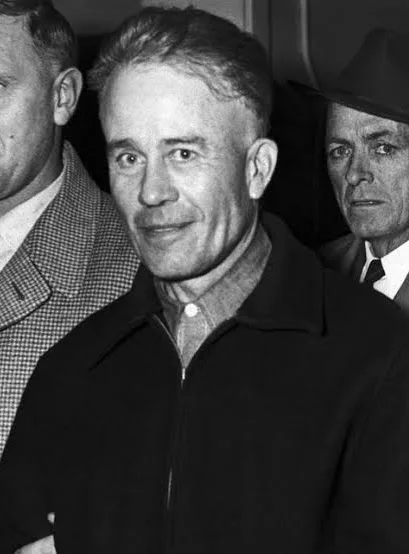
Ed Gein: the Wisconsin case, the 1968 trial and its legacy
Edward Theodore Gein, known as Ed Gein, was found guilty of first-degree murder in Wisconsin in November 1968 but was ruled legally insane at the time of the offence. He was committed to state psychiatric care and never released. Although he was convicted of only one killing, the discoveries made at his farmhouse in 1957 made his name widely known in the United States and abroad.
Background
Gein was born on 27 August 1906 in La Crosse, Wisconsin. His family later settled on an isolated farm near Plainfield, in Waushara County. His father, George, died in 1940. His brother, Henry, died in 1944 during a fire on marshland near the property, and the death was treated as accidental. His mother, Augusta, died in 1945, leaving Gein alone on the farm.
Neighbours knew him as a quiet man who did odd jobs and sometimes looked after children. Little in his public life suggested what investigators would later find.
The 1957 arrest
On 16 November 1957, Bernice Worden, who ran a hardware store in Plainfield, was reported missing. The shop had been left unattended and there were signs of a violent struggle. Her son, Frank Worden, was a deputy sheriff. Investigators learned that Gein had been in the store the day before and had said he would be back to buy antifreeze.
Officers went to his farm and found Mrs Worden's body in an outbuilding. A wider search of the house turned up human remains and objects that police said had been made from them. Gein, then 51, was taken into custody.
Admissions to police
According to the accounts of his statements, Gein admitted killing Bernice Worden. He also admitted killing Mary Hogan, a tavern owner who had disappeared in December 1954. He said that he had visited local cemeteries over a number of years and removed remains from graves. Investigators established that some of the remains found at the farm came from graves and not from killings. He was formally charged only in connection with Mrs Worden's death.
Fitness to stand trial
Gein was not tried immediately. In January 1958, a court in Waushara County found him mentally unfit to stand trial. This is a separate question from guilt. It asks whether a defendant can understand the proceedings and help in their own defence. He was sent to the Central State Hospital for the Criminally Insane at Waupun.
He remained there for about a decade. In 1968, doctors reported that he had become fit to face trial, and the case went before the court.
The 1968 trial
The trial took place in Wautoma in November 1968 before Judge Robert Gollmar. Gein had waived his right to a jury, so the judge alone decided the outcome. Wisconsin procedure at the time allowed a two-stage process. The first stage decided whether the defendant committed the offence. The second considered whether he was legally insane when he did so.
The judge found Gein guilty of first-degree murder. In the second stage, after hearing medical evidence, he ruled that Gein had been legally insane at the time. Under that finding, Gein was not sentenced to a prison term. He was committed to a secure psychiatric institution instead.
What the verdict meant
A finding of this kind is often misunderstood. It is not an acquittal in the ordinary sense, and it does not mean the defendant is free. The court holds that responsibility is removed by mental illness, and the person is detained for treatment for as long as the authorities judge necessary. In Gein's case, that meant the rest of his life.
Later years and death
Gein was held at Central State Hospital and was later transferred to the Mendota Mental Health Institute in Madison. Staff and officials described him as a compliant patient. No further proceedings were brought against him over the Hogan killing or the graves.
He died at Mendota on 26 July 1984, aged 77. He was buried in Plainfield Cemetery, in the same plot as his family.
The farm and the aftermath
The farmhouse was due to be sold at auction in 1958 but was destroyed by fire in March of that year. The cause was never established in court, though arson was widely suspected. Some of Gein's belongings were later sold, and his car was displayed as a curiosity at fairs, which drew criticism at the time. In 2000, his gravestone was stolen. It was recovered the following year.
Cultural influence
Gein's case had an outsized effect on popular fiction. Elements of it are widely recognised as inspiration for Robert Bloch's novel Psycho, published in 1959, and for later films including The Texas Chain Saw Massacre and The Silence of the Lambs. Those works are fictional and depart sharply from the real events. Gein's actual crimes were far fewer in number than the popular myth suggests.
Why the case matters
Legally, the case is an early example of how courts separate fitness to stand trial from criminal responsibility. It also shows how a defendant can spend many years in detention without a trial while doctors assess his condition. For the communities involved, particularly the families of Bernice Worden and Mary Hogan, the case was a personal loss before it became a subject of public fascination. A careful account keeps the focus on what the court record shows and on the two women who were killed.