
Donald Trump: the court cases, convictions and appeals
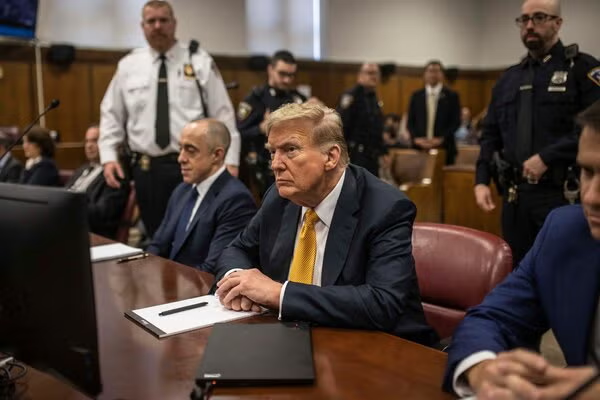
A Manhattan jury convicted Donald Trump of 34 counts of falsifying business records on 30 May 2024, making him the first current or former US president with a criminal conviction. He was later sentenced to an unconditional discharge, and he is appealing. This article sets out his main criminal and civil cases, how each ended or where it stands, and what the legal terms mean. Mr Trump denies wrongdoing in all of them.
The New York criminal case
The charges and verdict
The case was brought by the Manhattan District Attorney, Alvin Bragg. Prosecutors alleged that business records were falsified to conceal a $130,000 payment made before the 2016 election by Mr Trump's then lawyer, Michael Cohen, to the adult film actress Stormy Daniels. They said Mr Trump repaid Mr Cohen in instalments that were recorded falsely. Under New York law, falsifying records is a felony if it is done to commit or hide another crime, and prosecutors argued that the other offence was interference in the 2016 election.
The jury returned guilty verdicts on all 34 counts after a six-week trial before Judge Juan Merchan.
Sentence
On 10 January 2025, ten days before Mr Trump's second inauguration, Judge Merchan imposed an unconditional discharge. In plain English, the conviction stands but there is no jail, probation or fine. The US Supreme Court had declined to halt the sentencing beforehand.
The appeal
Mr Trump's lawyers filed their formal appeal on 27 October 2025 with the Appellate Division, First Department, which is New York's intermediate appeal court. They argue that the jury heard evidence connected to his official duties that the Supreme Court's 2024 immunity decision put out of bounds. They also argue that the judge should have stood aside and that the prosecution relied on a flawed legal theory. The District Attorney's office rejects these points and says the conduct was personal, not official. Oral argument has been reported as listed for 5 November 2026.
A parallel effort to move the case into federal court has also run through the courts. The Second Circuit sent the question back to a federal judge for further consideration in November 2025. That track is separate from the state appeal.
Cases that ended without trial
Three other criminal prosecutions did not reach a verdict.
- Federal election case: the special counsel, Jack Smith, moved to drop it after the 2024 election, citing a long-standing Justice Department policy against prosecuting a sitting president.
- Federal classified documents case: a judge dismissed it in July 2024, ruling that the special counsel had not been validly appointed. The matter did not revive after the election.
- Georgia racketeering case: Mr Trump and 18 others pleaded not guilty in August 2023. After the elected prosecutor, Fani Willis, was disqualified, the state prosecutors' council director, Pete Skandalakis, took over. On 26 November 2025 Judge Scott McAfee dismissed the case in its entirety at his request.
None of these produced a finding on the allegations, so they should not be described as acquittals.
The civil cases
New York civil fraud
The New York Attorney General, Letitia James, sued Mr Trump and his company over claims that asset values were inflated in financial statements to obtain better terms from lenders and insurers. In February 2024 Judge Arthur Engoron found them liable and ordered a penalty of about $354 million, which grew with interest to roughly $500 million.
On 21 August 2025 a divided Appellate Division panel threw out the financial penalty as an excessive fine under the Eighth Amendment, though it upheld the finding of liability by a narrow margin. The ruling kept restrictions on corporate leadership for Mr Trump and his two eldest sons for a limited period. The Attorney General has taken the case to the New York Court of Appeals, the state's highest court, where it remains pending.
E. Jean Carroll
The writer E. Jean Carroll brought two civil claims in federal court in Manhattan. A civil jury decides on the balance of probabilities, a lower bar than the criminal standard of beyond reasonable doubt.
- First verdict (2023): the jury awarded her $5 million after finding Mr Trump liable for sexual abuse and defamation. The Supreme Court declined to hear his appeal in June 2026 and refused a request to reconsider on 17 August 2026, so that verdict is final.
- Second verdict (2024): a separate jury awarded $83.3 million for defamation over later denials. The Second Circuit upheld that award, and in July 2026 Mr Trump asked the Supreme Court to overturn it, arguing that he has presidential immunity for statements made in office. The most recent reports found said the court had not yet acted on that petition.
Presidential immunity
The Supreme Court's 2024 decision gave a president broad protection from prosecution for official acts, and it underpins several of Mr Trump's arguments. Courts are now deciding how that line applies to a state criminal trial and to civil claims about public statements. Judges have so far treated the question as one of timing and evidence, as well as principle. In the Carroll litigation, the appeal judges said the immunity argument had been raised too late.
What remains to be decided
As of late October 2026, three matters are open: the New York criminal appeal, the civil fraud appeal in the Court of Appeals and the Supreme Court petition on the $83.3 million Carroll verdict. Each could take months. The criminal conviction remains in place unless and until an appeal court rules otherwise.