
How murder trials work in Japan and the United Kingdom
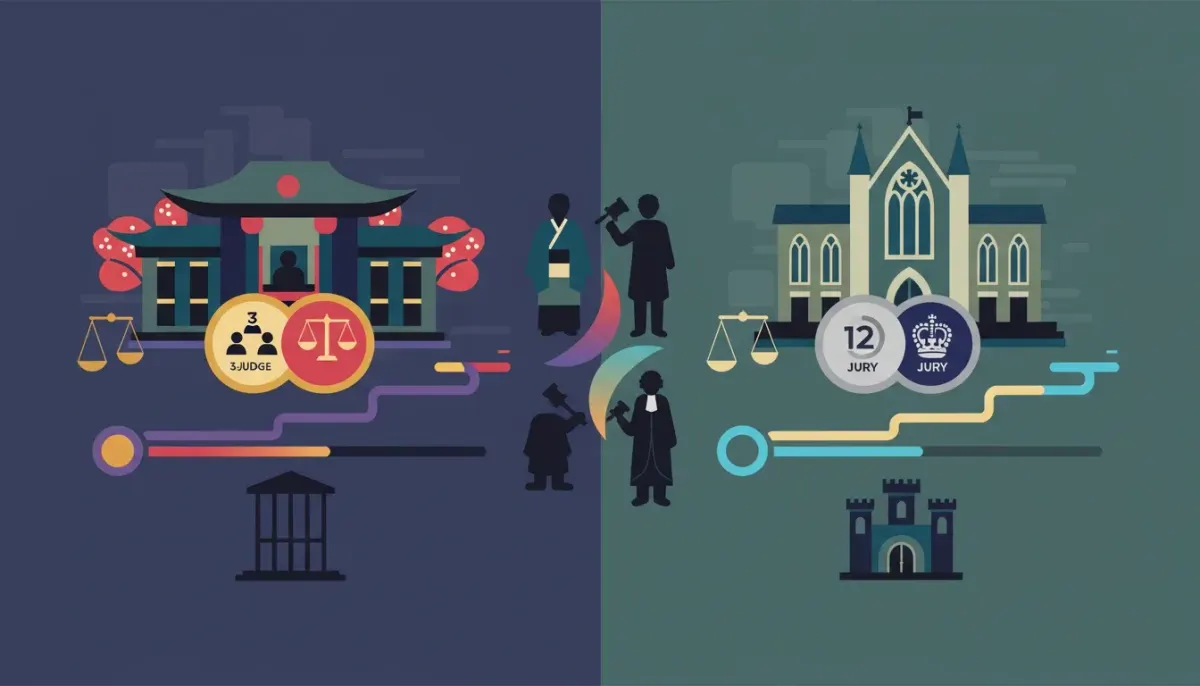
Murder trials in Japan and the United Kingdom share core principles: the accused is presumed innocent, hearings are generally held in public, and the prosecution must prove its case. Yet the two systems differ in who decides the verdict, how long a suspect can be questioned before charge, and what sentences are available. This guide explains the main differences in plain terms, with simple illustrations along the way. The UK has three legal systems, so unless stated, the UK description refers to England and Wales.
At a glance
| Question | Japan | England and Wales |
|---|---|---|
| Who decides the verdict? | A mixed panel of professional judges and lay judges | A jury of 12 citizens in the Crown Court |
| Who decides the sentence? | The same mixed panel, together with the verdict | The trial judge alone |
| Longest detention before charge or indictment | Up to 23 days on one set of allegations | Up to 96 hours, with court approval after 36 hours |
| Lawyer in the interview room? | Not normally | Yes, if the suspect wishes |
| Death penalty? | Available by law for murder | No |
Before the trial: arrest and detention
Japan
Police may hold a suspect for up to 48 hours before passing the case to prosecutors, who have a further 24 hours to ask a judge for detention. A judge can then authorise 10 days of detention, extendable by up to another 10 days. In total, a suspect can be held for up to 23 days on one set of allegations before prosecutors must decide whether to indict, which means formally bringing the case to court. Suspects can be arrested again on separate allegations, which has drawn long-running criticism from lawyers' groups.
A suspect has the right to a lawyer, but the lawyer cannot normally sit in on police questioning. Since 2019, the full recording of interrogations has been required in cases heard by lay judges, which include murder.
Illustration (hypothetical): a person is arrested on suspicion of murder on a Monday. Police questioning can continue for up to two days, after which prosecutors take over and seek a judge's order. If the order is granted and extended, the person may remain in custody for several weeks before any indictment decision. During that time the person may meet a lawyer, but the lawyer would wait outside the interview room.
England and Wales
Police can normally hold a suspect for 24 hours, extendable to 36 hours for serious offences by a senior officer. A magistrates' court can authorise detention without charge for up to 96 hours in total. A solicitor can be present during interviews, and all interviews are recorded. The Crown Prosecution Service (CPS) decides whether to charge, based on whether there is enough evidence and whether prosecution is in the public interest. Once a person is charged, they are usually brought before a magistrates' court quickly. Because murder can only be tried in the Crown Court, the magistrates send the case there.
Illustration (hypothetical): a person is arrested on suspicion of murder and interviewed with a solicitor present. If police need more time after 36 hours, they must apply to a magistrates' court. At the end of the permitted period, the person must be charged, released on bail, or released under investigation. A person who is charged is described as the defendant and remains presumed innocent.
Who decides the verdict
Japan: the lay judge system
Since 2009, serious criminal cases in Japan, including murder, are heard by the saiban-in system. A panel of citizens known as lay judges sits alongside professional judges. They are selected by lottery from the electoral roll. In a typical contested murder case the panel has six lay judges and three professional judges. Together they decide whether the defendant is guilty and, if so, what the sentence should be. A guilty verdict needs a majority that includes at least one professional judge and at least one lay judge.
Lay judges can question witnesses and the defendant in court. Pre-trial meetings among the judges and lawyers are used to narrow the issues, so that the hearing can run in a concentrated period rather than being spread over many months.
England and Wales: trial by jury
In the Crown Court, 12 jurors, chosen at random from the electoral register, decide only the facts: guilty or not guilty. The judge directs them on the law and manages the trial but does not decide guilt. Jurors are asked to reach a unanimous verdict. If they cannot after a reasonable period, the judge may accept a majority verdict of 11 to one or 10 to two.
Jurors deliberate in private and cannot discuss the case outside the jury room. Members of the public and the media who report on the case must also take care not to publish anything that could prejudice the trial, as that may amount to contempt of court.
How the trial unfolds
In both countries the prosecution presents its case first and must prove it to the required standard: beyond reasonable doubt in the UK, and to a similarly high standard in Japan. The defence may challenge the evidence, call witnesses, or offer an alternative account. The defendant has the right to remain silent in both systems.
Japan also allows bereaved family members in some serious cases to take part in the trial as participating victims. With the court's permission, they can sit near the prosecutors, question certain witnesses and the defendant, and state their views on sentence. In England and Wales, bereaved families can read a victim personal statement to the court at the sentencing stage, but they do not take part in the trial itself.
Sentences
Japan
The Penal Code provides for murder to be punished by death, life imprisonment, or a fixed term of imprisonment of at least five years. The court chooses within that range after considering factors such as the circumstances of the offence, the number of victims, the motive and the defendant's background. Executions, where carried out, are by hanging.
England and Wales
Murder carries a mandatory sentence of life imprisonment for adults. The judge then sets a minimum term, which is the least time the offender must serve before the Parole Board can consider release. Release is not guaranteed after that point, and an offender who is released remains on licence for life and can be recalled to prison. In the most serious cases, a judge may impose a whole life order, which means the offender is not expected ever to be released. An early guilty plea can reduce the minimum term. There is no death penalty.
Illustration (hypothetical): if two defendants were each convicted of murder in the two countries, the Japanese panel would choose between the penalties set by law, while the English judge would impose life imprisonment and spend the sentencing hearing deciding the minimum term.
Appeals
In Japan, both the defence and the prosecution can appeal a first-instance decision to a High Court, and from there on limited grounds to the Supreme Court. This means prosecutors can challenge an acquittal. In England and Wales, a convicted defendant can seek permission to appeal to the Court of Appeal (Criminal Division). Prosecutors cannot generally appeal a jury's not guilty verdict, although there are narrow exceptions, including a retrial where new and compelling evidence emerges in serious cases. The Attorney General can also ask the Court of Appeal to review a sentence thought to be unduly lenient.
Frequently asked questions
Is a suspect guilty if they are charged or indicted?
No. In both countries, a person who has been charged or indicted is only accused of an offence. They are presumed innocent unless a court convicts them.
Do ordinary people really decide murder cases in Japan?
Yes, but alongside professional judges. Lay judges take part in deciding both guilt and sentence, whereas English jurors decide guilt only.
Why is pre-charge detention so much longer in Japan?
Japanese law allows detention in stages, authorised by a judge, while prosecutors prepare the case. Critics, including some lawyers' groups, argue that it puts pressure on suspects. Supporters say the process is supervised by judges and the recording of interrogations adds a safeguard in lay judge cases.
Can a lawyer attend police questioning?
In England and Wales, yes. In Japan, a lawyer can advise a suspect but cannot normally be present in the interview.
Does life imprisonment mean the same in both countries?
Not necessarily. In England and Wales, the judge sets a minimum term, and release depends on the Parole Board. Japan has its own rules on life sentences and parole, so figures and practices should not be compared without checking the specific law and the specific case.
Are murder trials open to the public?
Generally yes in both countries, although courts can restrict reporting or limit public access in particular circumstances, for example to protect children or victims of sexual offences.
Can a not guilty verdict be challenged?
In Japan, prosecutors may appeal an acquittal. In England and Wales, this is possible only in rare, tightly defined circumstances.