
How courts in India handle high-profile murder cases
A murder case that draws national attention in India follows the same legal path as any other. What changes is the scrutiny: the investigation, bail decisions and trial are watched closely by the public, the press and higher courts. This article explains the main stages and the safeguards that apply.
The legal framework
India's criminal law was rewritten in 2024. The Bharatiya Nyaya Sanhita replaced the Indian Penal Code, the Bharatiya Nagarik Suraksha Sanhita replaced the Code of Criminal Procedure, and the Bharatiya Sakshya Adhiniyam replaced the Evidence Act. Murder, formerly covered by section 302 of the Indian Penal Code, is now dealt with under section 103 of the new code. Offences committed before the changes took effect are generally still handled under the older laws.
India follows the common law tradition. A judge, not a jury, decides guilt, and the prosecution must prove its case beyond reasonable doubt. A person charged with murder is presumed innocent until a court convicts them.
From complaint to charge
The first information report
A case usually begins with a First Information Report (FIR), the police record of the initial complaint. Officers then investigate, collect forensic and digital material, and record witness statements. In some cases a state police force is replaced as investigator by a national or specialist agency, such as the Central Bureau of Investigation (CBI). High Courts and the Supreme Court can order such a transfer if they believe an investigation needs to be independent or has been unfair.
The chargesheet
When the inquiry ends, police file a final report, commonly called a chargesheet, before a magistrate. If it discloses enough material, the magistrate sends, or “commits”, the case to the Sessions Court, which is the court that tries murder.
Bail and custody
Bail in murder cases is not automatic. Courts consider the seriousness of the allegation, the strength of the material so far, the risk of interference with witnesses and whether the accused may flee. A refusal at one level can be challenged before the High Court and then the Supreme Court. A grant of bail is not a finding about guilt, and it can be cancelled if conditions are broken.
The trial
A Sessions judge hears the case. The main steps are:
- The court frames the charges after hearing both sides on whether there is a case to answer.
- The accused is asked whether they plead guilty or wish to be tried.
- The prosecution, led by a public prosecutor, calls witnesses, who are cross-examined by the defence.
- The accused is questioned by the court about the evidence against them. This is not sworn testimony.
- The defence may call its own evidence.
- Both sides make final arguments and the judge delivers a reasoned judgment.
In high-profile cases, the government may appoint a special public prosecutor, and the court may set daily hearings to speed matters up. Trials can still take years, because of heavy caseloads and the number of witnesses.
Types of evidence
Many cases rest on circumstantial evidence, meaning facts from which guilt may be inferred. Courts require that such evidence form a complete chain pointing only to the accused. Electronic material, such as phone records or CCTV footage, must meet formal conditions before it is admitted.
Media coverage and fair trial
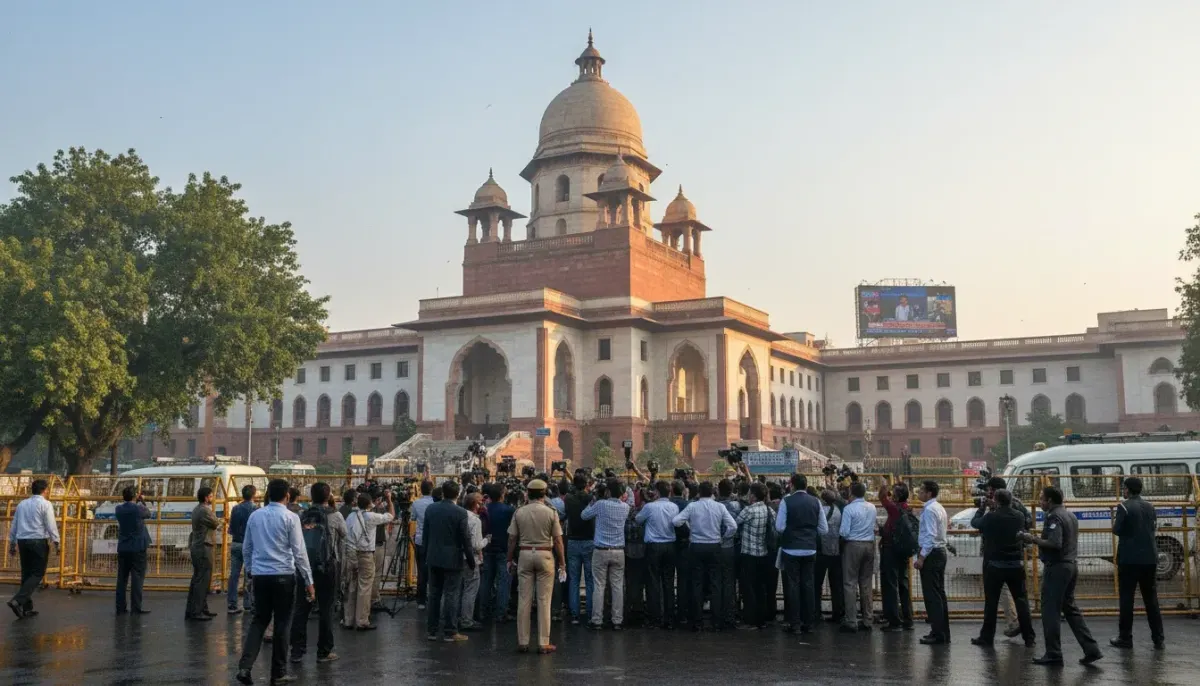
Indian courts have repeatedly stressed that press coverage should not prejudge a case. Judges can restrict reporting, order hearings to be held in private, or limit publication of certain details when a fair trial is at risk. The identity of victims of sexual offences is protected by law. Journalists may report what is said in open court, but commentary that treats an accused person as guilty before a verdict raises legal and ethical concerns.
The Supreme Court can also move a trial to another state if it finds that a fair hearing cannot take place where the case began.
Sentencing
The punishment for murder is death or imprisonment for life, together with a fine. The death penalty is reserved for the “rarest of rare” cases, a standard developed by the Supreme Court. If a Sessions Court imposes a death sentence, it cannot be carried out until the High Court confirms it. Judges consider the circumstances of the crime and of the offender before sentencing. “Life imprisonment” ordinarily means the remainder of the person's natural life, unless a government lawfully reduces it.
Appeals
A convicted person has a right to appeal to the High Court, which re-examines the evidence and can uphold, overturn or modify the verdict. A further challenge may be brought to the Supreme Court by seeking special permission, known as a special leave petition. Review petitions and, as a last judicial option, curative petitions are also possible. Where a death sentence stands