
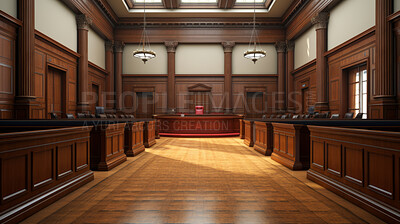
Who sits where in a courtroom and what each person does
A courtroom can look bewildering to anyone seeing one for the first time. Every seat has a purpose, and every person present has a defined job. This criminal trial guide explains who is in a courtroom, where they usually sit and what they do. It also explains how international courts differ from national ones. Layouts vary between countries and between buildings, but the basic logic of court procedure is similar almost everywhere.
The bench: the judge or judges
The judge normally sits at the front, on a raised platform called the bench, so that they can see and hear the whole room. Their task is to run the hearing fairly, decide questions of law, rule on what evidence may be heard and keep order. In a trial with a jury, the judge does not decide guilt. In a trial without one, the judge or a panel of judges decides both the facts and the law, and gives reasons for the decision.
Judge and jury
Where a jury is used, it sits to one side, often in raised rows, in view of the witness box. In England and Wales a jury has 12 members; other systems use different numbers. Jurors listen to the evidence, follow the judge's directions on the law and decide whether the prosecution has proved its case to the required standard. They then retire to deliberate in private. Their role is limited to the verdict. In England and Wales, sentencing is for the judge.
The well of the court: the working core
The area in front of the bench is often called the well. It is where the professional participants sit.
- Court clerk or associate: sits directly below or beside the judge. The clerk manages the court list, records outcomes, swears in witnesses and puts the charges to the defendant.
- Court reporter or stenographer: produces an official record of what is said, by shorthand, machine or audio recording, depending on the jurisdiction.
- Interpreter: translates for a defendant or witness who does not speak the language of the court, so that everyone can follow the proceedings.
- Usher or bailiff: keeps order, calls witnesses, looks after the jury and helps people find their way around the room.
Prosecution and defence
The prosecution and defence usually sit facing the bench, on opposite sides or at separate tables. The prosecutor presents the case for the state, or for the Crown in some jurisdictions. The prosecutor sets out the allegations, calls witnesses and questions them. The defence lawyer represents the accused, tests the prosecution evidence through cross-examination and may call witnesses for the defence. A defendant is presumed innocent, and the burden of proof rests on the prosecution throughout.
Where the defendant sits
This differs by country. In England and Wales the defendant usually sits in the dock, a enclosed area at the back of the court, often alongside a security officer. In the United States the defendant typically sits at the defence table next to their lawyer. In some civil law systems, the defendant may be seated nearer the bench and questioned directly by the presiding judge.
The witness box
Witnesses give evidence from a box or stand, usually close to the judge and jury. They take an oath or make an affirmation to tell the truth. Evidence generally follows a set order: questions from the side that called the witness, then cross-examination by the other side, then any follow-up questions. Some witnesses, such as vulnerable people, may give evidence by video link or from behind a screen.
The public gallery and the press
Most trials are held in open court, so members of the public can sit in the gallery. Journalists usually have a reserved area. Open justice is a core principle, but judges can restrict reporting or clear the public from the room in limited circumstances, for example to protect children or national security. Phones and recording devices are normally restricted.
How a trial usually unfolds
- The charges are read and the defendant enters a plea.
- The prosecution outlines its case and presents evidence.
- The defence responds and may present its own evidence.
- Both sides make closing arguments.
- The judge sums up the law, and the jury or judges reach a verdict.
- If there is a conviction, the court moves to sentencing, which may take place later.
International courts: a different room
International courts follow the same principles of fairness, but their rooms and personnel differ. The International Criminal Court tries individuals before a chamber of judges rather than a jury. Its courtrooms also include legal representatives for victims and a large interpretation team, because proceedings run in more than one language. The International Court of Justice hears disputes between states, so there is no dock. Each state is represented by an agent and by counsel, and a bench of judges hears the case.
Why the layout matters
The arrangement of a courtroom reflects the values of the legal system it serves. It separates decision-makers from advocates, allows the accused to participate in their defence and gives the public a view of the process. Knowing who is in the room and what each person does makes it far easier to follow a trial, whether you are in the gallery or reading a report of the day's hearing.