
How a jury is chosen: methods in the US, England and Wales
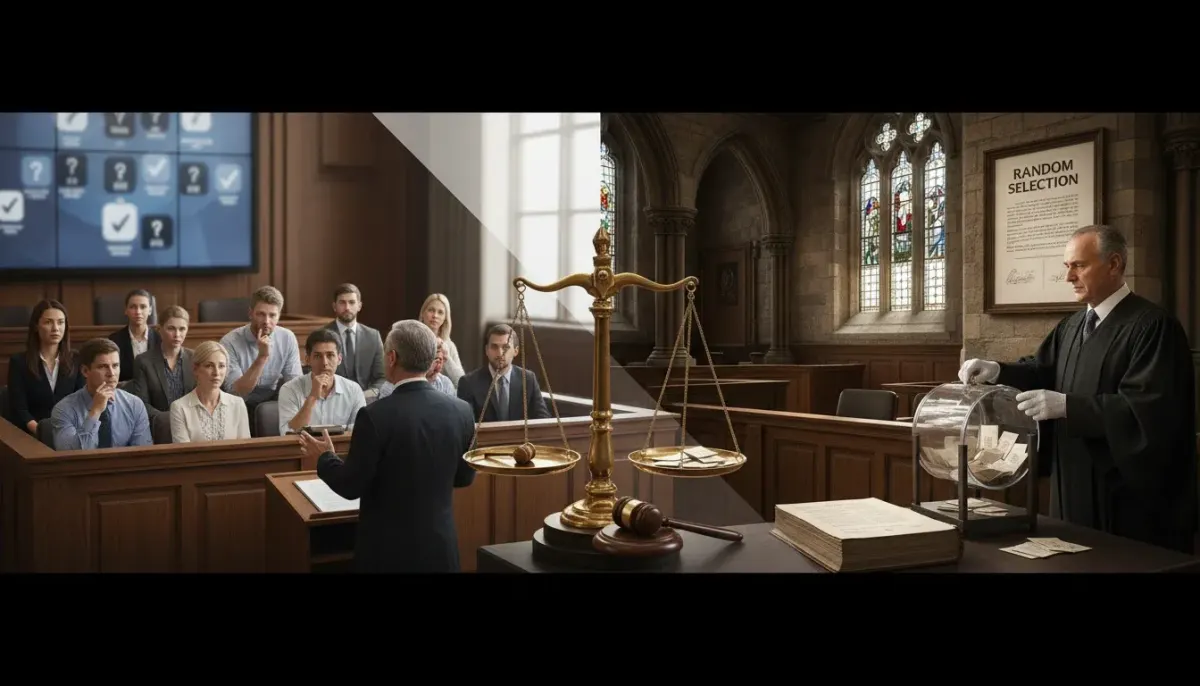
A jury trial rests on a simple idea: ordinary members of the public decide the facts of a case. How those people are chosen, and how far the lawyers can shape the group, varies widely between legal systems. This guide explains the main methods of jury selection in the United States, in England and Wales, and in a selection of other countries.
Why jury selection matters
A verdict is only as credible as the process that produces it. Most systems aim for a panel that is representative of the community and able to judge the evidence fairly. They differ on how to reach that goal. Some trust random selection to deliver balance. Others let lawyers question prospective jurors and remove those they consider unsuitable.
The United States: questioning and challenges
From the jury pool to the courtroom
Courts in the US usually build a pool of potential jurors from public lists, such as voter registrations and driving licence records. Those people receive a summons and report to the court on a set date. Groups are then sent to individual courtrooms, where a smaller panel is questioned for a particular case.
Voir dire
The questioning stage is known as voir dire, a term from older French that is often explained as “to speak the truth”. The judge, the lawyers, or both put questions to prospective jurors about their background, their connections to the case and any views that might affect their judgement. In high-profile cases, courts sometimes use written questionnaires as well. The length of voir dire varies greatly: it can take an afternoon in a routine case and much longer where publicity has been intense.
Two kinds of challenge
Each side can ask the judge to remove a prospective juror in two ways:
- Challenge for cause: the lawyer argues that the person cannot be impartial, for example because of a close link to a witness. The judge decides, and there is no fixed limit on these challenges.
- Peremptory challenge: the lawyer removes a person without giving a reason. Each side has a limited number, which differs between federal courts and the states.
Peremptory challenges are not unlimited in purpose. In Batson v Kentucky (1986), the Supreme Court ruled that prosecutors may not use them to exclude people because of race, and later decisions extended similar protection to other grounds. If a party objects, the lawyer may have to give a neutral explanation.
Most serious criminal trials use 12 jurors, though some states allow fewer for less serious offences. Courts often seat extra alternates in case a juror cannot continue. Since the Supreme Court’s decision in Ramos v Louisiana (2020), a unanimous verdict is required in state felony trials as well as federal ones.
England and Wales: random selection
In England and Wales, juries sit mainly in the Crown Court. Jurors are drawn at random from the electoral register by a central summoning bureau, under the Juries Act 1974. In general, a juror must be aged 18 to 75, registered to vote, and have lived in the UK for at least five years since the age of 13. People with certain criminal convictions or sentences, and some people on bail, are disqualified.
On the day of the trial, a panel of potential jurors waits at court. Names are chosen at random in open court, and 12 people are sworn in or affirm. There is no equivalent of voir dire. Lawyers do not question jurors